
AI Search & Web Analytics Specialist
Table of Contents
For years, digital advertising has been built around a familiar set of signals.
- Someone searches for a product.
- Visits a website.
- Clicks on an ad.
- Browses a category.
- Adds an item to a cart.
These interactions have powered audience targeting across major advertising platforms and have helped brands reach potential customers at scale.
But as AI becomes deeply embedded into ecommerce, another type of signal is becoming increasingly valuable:
Purchase signals.
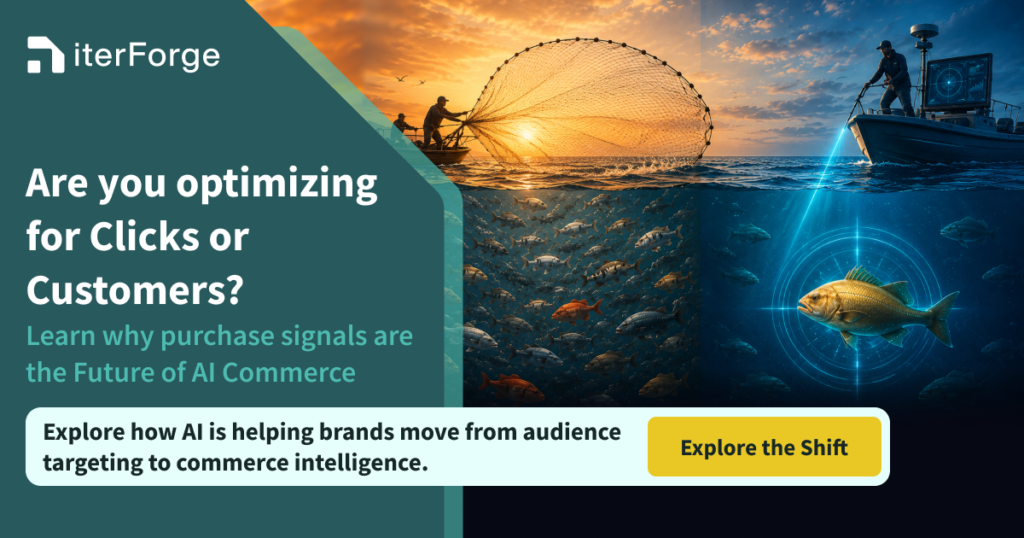
Instead of asking “What is a customer interested in?”, AI can now ask a much more meaningful question:
“What has this customer actually purchased?”
That shift may sound subtle, but it has implications that go far beyond advertising.
It represents a move toward commerce ecosystems that continuously learn from customer behaviour, the foundation of what many now describe as Agentic Commerce.
From Interest Signals to Purchase Intelligence
Traditional digital advertising largely relies on behavioural signals.
These include:
- Search queries
- Website visits
- Product page views
- Demographic data
- Interests
- Previous ad engagement
While these signals are useful, they don’t always translate into buying intent.
Someone may browse premium running shoes for weeks without making a purchase.
Another customer may quietly purchase high-end fitness products every month without performing many online searches.
Both customers appear very different when viewed through actual purchasing behaviour.
This is where purchase signals become valuable.
Instead of predicting intent from browsing activity alone, AI can analyse purchasing patterns such as:
- Categories customers buy repeatedly
- Preferred price ranges
- Purchase frequency
- Brand affinity
- Seasonal buying behaviour
- Cross-category relationships
The result is a far richer understanding of customer intent.
AI Is Turning Commerce Data into Competitive Advantage
Purchase signals become truly powerful when combined with Ecommerce AI & Data.
Modern AI systems can analyse millions of customer interactions across multiple touchpoints to uncover patterns that would be impossible to identify manually.
Rather than relying on static audience segments, AI continuously learns from customer behaviour.
Imagine two shoppers who both fit the same demographic profile.
Traditional advertising might place them in the same audience.
However, AI may recognise that one consistently purchases premium beauty products while the other prefers value-focused alternatives.
Instead of showing both shoppers identical campaigns, AI can personalise recommendations, messaging, offers, and experiences based on actual buying behaviour rather than assumptions.
This is where commerce begins shifting from broad targeting to intelligent decision-making.
But Purchase Signals Shouldn’t Stop at Advertising
This is where the conversation becomes much bigger.
Many discussions around purchase signals focus exclusively on advertising performance.
But for ecommerce businesses, the same intelligence can improve almost every customer interaction.
Purchase behaviour can influence:
- AI-powered product discovery
- Intelligent merchandising
- Personalized recommendations
- Conversational shopping assistants
- Search relevance
- Customer segmentation
- Loyalty experiences
- Inventory planning
- Predictive demand forecasting
In other words, purchase signals are not simply another marketing dataset.
They become a shared layer of intelligence across the entire commerce ecosystem.
This is one of the defining principles behind Agentic Commerce connected AI capabilities that continuously learn, adapt, and optimise experiences rather than operating as isolated tools.
Personalization Becomes More Meaningful
Personalization has existed in ecommerce for years. However, much of it still relies on relatively simple rules.
- Customers who viewed one product are shown similar products.
- Visitors who abandoned a cart receive reminder emails.
- Users are grouped by age, location, or interests.
Purchase signals allow personalization to evolve beyond these traditional approaches.
Instead of asking: “What did this customer click?”
Businesses can begin asking:
“What purchasing patterns has this customer consistently demonstrated?”
That change creates opportunities for more relevant product recommendations, more meaningful offers, and customer experiences that feel genuinely tailored rather than broadly segmented.
Measuring Business Outcomes Instead of Marketing Metrics
Another important shift is how success is measured.
Traditional advertising often focuses on metrics such as:
- Impressions
- Clicks
- CTR
- CPC
While these remain useful, they don’t necessarily reflect business impact.
AI-powered commerce increasingly measures outcomes that matter to business leaders.
These include:
- Revenue generated
- Return on Ad Spend (ROAS)
- Customer Acquisition Cost (CAC)
- Customer Lifetime Value (CLV)
- Repeat purchase behaviour
- Incremental sales
The focus moves away from “Did someone engage with the advertisement?”
Toward a far more valuable question:
“Did this customer create measurable business value?”
The Future Belongs to Connected Commerce Ecosystems
One of the biggest lessons emerging across the ecommerce industry is that customer data should no longer exist in silos.
- Advertising platforms.
- Commerce platforms.
- Analytics.
- Customer support.
- Search.
- Merchandising.
These systems become significantly more valuable when they learn from one another.
Purchase signals are one example of how this connected intelligence can work.
Rather than improving only advertising performance, they can strengthen every stage of the customer journey, from discovery and personalization to conversion and retention.
Also Read: How AI Sales Assistants Help B2B Commerce Teams Sell Faster Without Replacing Humans
Why This Matters for AI Search
Another emerging opportunity lies in Answer Engine Optimization (AEO) and Generative Engine Optimization (GEO).
As customers increasingly discover products through AI assistants and conversational search experiences, relevance will depend on more than keywords alone.
Future commerce experiences will combine:
- Rich product data
- Customer intent
- Purchase behaviour
- Contextual recommendations
- AI-generated answers
Brands that build structured, intelligent commerce ecosystems today will be better positioned to remain discoverable as AI search continues to evolve.
Also Read: Personalization Beyond Recommendations: How AI Agents Create One-to-One Commerce Experiences
What Ecommerce Leaders Should Be Thinking About
Whether a business advertises through search engines, social platforms, marketplaces, or emerging commerce media, the underlying question remains the same:
Is your commerce ecosystem learning from customer behaviour or simply collecting data?
Forward-looking organisations should begin evaluating:
- Is customer data connected across platforms?
- Are AI models learning from real purchasing behaviour?
- Can purchase intelligence improve personalization beyond advertising?
- Are analytics measuring revenue impact instead of just engagement?
- Is the organisation preparing for AI-driven discovery through AEO and GEO?
These questions will become increasingly important as AI transforms how customers discover, evaluate, and purchase products.
Final Thoughts
Purchase-signal-driven advertising is not simply another advertising trend.
It reflects a broader transformation happening across digital commerce.
The future of ecommerce will not be defined by isolated AI features or better ad targeting alone. It will be shaped by connected commerce ecosystems where AI continuously learns from customer behaviour to improve discovery, personalization, merchandising, analytics, and customer experiences.
For ecommerce leaders, the opportunity is much larger than improving campaign performance.
It is about building an intelligent commerce foundation where Ecommerce AI & Data, Agentic Commerce, AEO, GEO, personalization, and analytics work together to create experiences that are smarter, more relevant, and measurable.
Because in the AI era, the brands that win won’t just have more customer data.
They’ll know how to turn that data into better commerce decisions.