
Table of Contents
Retailers are no longer debating whether artificial intelligence belongs in ecommerce.
The conversation has shifted.
Today, retail leaders are asking a much more practical question:
Where should we start?
Should AI improve search? Should it optimize merchandising? Should it power sales assistants? Or should personalization come first?
The answer isn’t choosing one over another.
The biggest gains happen when these capabilities work together as connected, intelligent systems that continuously learn from customer behavior and business outcomes. This is the foundation of Agentic Commerce.
According to McKinsey, organizations that effectively deploy AI can improve customer satisfaction by 15 to 20%, increase revenue by 5 to 8%, and reduce cost to serve by 20 to 30%. Those numbers don’t come from isolated AI features; they come from AI working across the customer journey.
The encouraging news is that retailers don’t need to replace their ecommerce platform to begin realizing these benefits. With the right strategy, AI can be layered onto existing commerce systems while delivering measurable value in weeks rather than years.
Here’s a practical roadmap for making that happen.
Also Read: How Retailers Can Enhance Product Discovery with AI Without Rebuilding Their Commerce Platform
What is Agentic Commerce?
Agentic Commerce is an approach where multiple AI-powered agents collaborate across the ecommerce experience to achieve business goals autonomously.
Instead of simply responding to customer requests, these AI agents continuously observe customer behaviour, understand intent, make decisions, and optimize experiences in real time.
Unlike traditional automation, which follows predefined rules, Agentic Commerce enables systems to:
- Understand customer intent rather than keywords
- Learn from every interaction
- Adapt merchandising dynamically
- Recommend next-best actions
- Optimize experiences across channels
- Improve continuously without constant manual intervention
Rather than functioning as separate AI tools, search, merchandising, sales assistance, and personalization become interconnected decision-making systems.
Also Read: How AI Sales Assistants Help B2B Commerce Teams Sell Faster Without Replacing Humans
Why Retailers Don’t Need a Rebuild to Adopt AI
One of the biggest misconceptions surrounding AI adoption is that retailers must replace their existing ecommerce platform.
In reality, most organizations already possess the critical ingredients:
- Customer behaviour data
- Product catalogues
- Search logs
- Analytics platforms
- CRM and loyalty systems
- Existing commerce platforms
The missing piece isn’t infrastructure. It’s intelligence.
Modern AI solutions integrate through APIs, middleware, customer data platforms, search engines, and analytics tools. Instead of replacing existing investments, AI enhances them.
Many retailers begin with one high-impact capability and expand gradually.
Typical integration points include:
- Site search
- Recommendation engines
- Product merchandising
- Customer support
- Marketing automation
- Analytics platforms
This incremental approach reduces implementation risk while generating measurable ROI early in the journey.
AI for Product Discovery
Search remains one of the highest-impact opportunities in ecommerce.
Traditional search assumes customers know exactly what they’re looking for.
Customers rarely do.
Modern AI-powered search understands context, intent, synonyms, product relationships, and behavioural signals.
Instead of matching keywords, AI answers customer needs.
For example:
A shopper searching for: “running shoes for flat feet” shouldn’t receive products containing only the words running or shoes.
AI understands the medical condition, customer intent, preferred product characteristics, previous browsing behavior, inventory availability, and even likely price range.
It can also:
- Correct spelling automatically
- Interpret conversational queries
- Recommend complementary products
- Surface trending products
- Prioritize high-converting inventory
- Learn from unsuccessful searches
Product discovery becomes significantly faster while reducing customer frustration and improving conversion rates.
AI for Merchandising
Traditional merchandising depends heavily on manual rule creation.
Category managers spend countless hours adjusting product rankings, promotional placements, seasonal collections, and inventory priorities.
AI transforms merchandising from reactive to adaptive.
Instead of static product ordering, AI continuously evaluates:
- Inventory levels
- Margin
- Conversion probability
- Customer segments
- Weather
- Regional demand
- Promotional performance
- Customer engagement
If one product begins outperforming similar items, AI can automatically increase its visibility.
If inventory becomes constrained, merchandising adjusts immediately without manual intervention.
Retail teams remain in control while AI handles thousands of optimization decisions that humans cannot realistically manage in real time.
The result is better inventory utilization, higher conversion rates, and improved merchandising efficiency.
AI for Sales Assistance
Customers increasingly expect immediate, knowledgeable assistance.
Unfortunately, much ecommerce chatbots still rely on scripted decision trees.
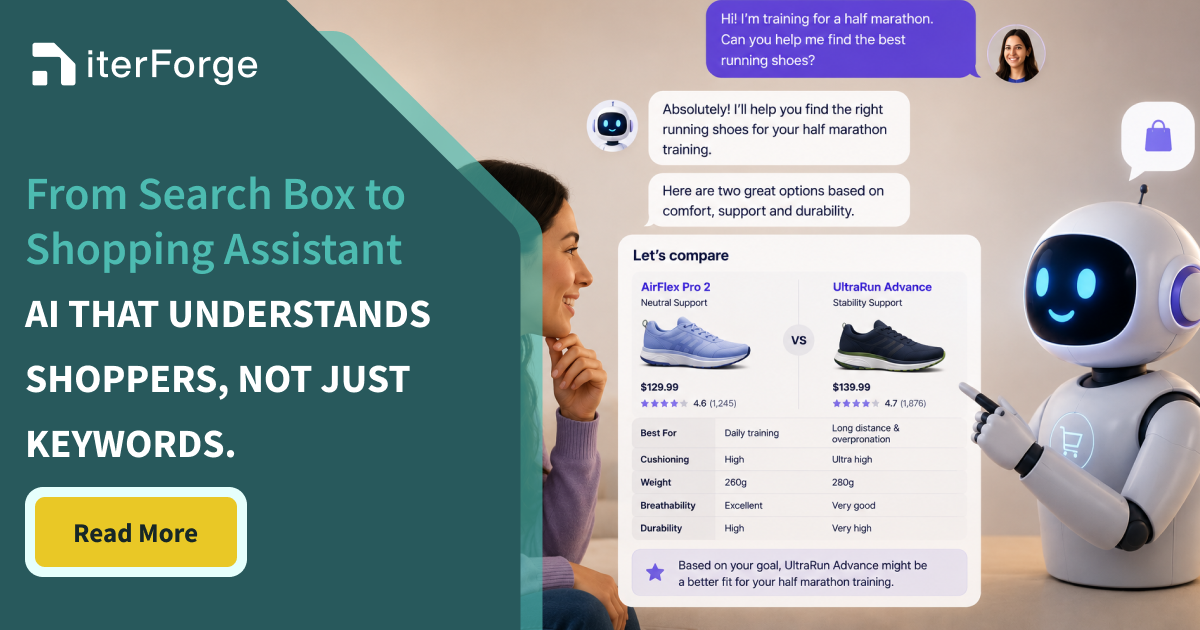
Modern AI sales assistants behave very differently.
- They understand conversations.
- They ask follow-up questions.
- They recommend products based on customer needs rather than predefined flows.
Imagine a customer shopping for a home espresso machine.
Instead of presenting a product list, the AI assistant asks:
- What’s your budget?
- How often will you use it?
- Do you prefer automatic or manual brewing?
- Is counter space limited?
- Are you upgrading from another machine?
Within seconds, customers receive highly relevant recommendations along with compatible accessories, warranties, financing options, and personalized promotions.
The experience resembles speaking with an experienced in-store sales associate, available 24/7 and capable of assisting thousands of customers simultaneously.
AI for Personalization
Most personalization today still revolves around:
“Customers who bought this also bought…”
That isn’t true personalization.
Modern AI evaluates dozens of real-time signals simultaneously.
It understands:
- Customer intent
- Shopping stage
- Purchase history
- Browsing behavior
- Device
- Location
- Loyalty status
- Session context
- Price sensitivity
- Promotion responsiveness
Instead of showing identical experiences to similar audiences, AI creates individualized journeys.
- Homepage banners change dynamically.
- Product recommendations evolve during browsing.
- Search results adjust based on customer goals.
- Promotions become increasingly relevant.
- Email follow-ups reflect actual shopping behaviour rather than generic campaigns.
- Every interaction becomes another learning opportunity that improves future recommendations.
This continuous optimization is one of the defining characteristics of Agentic Commerce.
AI Governance
As AI assumes greater responsibility across ecommerce operations, governance becomes essential.
Retailers need confidence that AI decisions remain accurate, explainable, compliant, and aligned with business objectives.
Equally important is ensuring that AI-powered customer experiences function reliably.
Successful AI governance includes:
- Monitoring AI decision quality
- Tracking recommendation accuracy
- Validating personalization performance
- Detecting experience failures
- Monitoring search quality
- Measuring customer satisfaction
- Ensuring data privacy compliance
- Identifying AI drift before business impact occurs
Without AI governance, retailers may unknowingly deploy AI experiences that reduce conversions, create inconsistent customer journeys, or introduce hidden friction.
The best-performing organizations continuously validate both the intelligence and the customer experience.
Also Read: Personalization Beyond Recommendations: How AI Agents Create One-to-One Commerce Experiences
Common Mistakes to Avoid
Many AI initiatives underperform because organizations focus on technology instead of customer outcomes.
Some of the most common pitfalls include:
Implementing isolated AI tools
Disconnected solutions create inconsistent customer experiences and fragmented insights.
Ignoring data quality
Even the best AI models depend on reliable Ecommerce AI & Data. Inaccurate product information or incomplete behavioural data limits performance.
Trying to automate everything immediately
Begin with one high-impact use case before expanding.
Measuring only technical metrics
Success should be measured using business outcomes such as revenue, conversion, customer satisfaction, and retention.
Skipping governance
AI systems require continuous monitoring to ensure accuracy, fairness, and compliance.
Treating AI as a one-time project
AI improves through continuous learning. Ongoing optimization should become part of normal business operations.
The Future Belongs to Connected AI
Retail is entering a new phase of Commerce Modernization. Winning organizations won’t simply deploy isolated AI features.
They’ll build connected ecosystems where search understands intent, merchandising adapts automatically, sales assistants guide purchasing decisions, and personalization evolves with every interaction.
The retailers that start today, even with a single AI capability, will be far better positioned than those waiting for the “perfect” transformation project. Agentic Commerce isn’t about rebuilding your business. It’s about making every customer interaction smarter than the last.