
AI Search & Web Analytics Specialist
Table of Contents
A customer asks ChatGPT…
“What’s the best protein powder for women?”
Within seconds, ChatGPT recommends three brands.
Your brand isn’t one of them.
You check Google. You’re ranking on Page 1 for several high-value keywords. Your product pages are optimized. Reviews are positive. Your structured data is in place.
So why didn’t the AI recommend you?
The explanation lies in a signal that many ecommerce brands have only recently started paying attention to: citations.
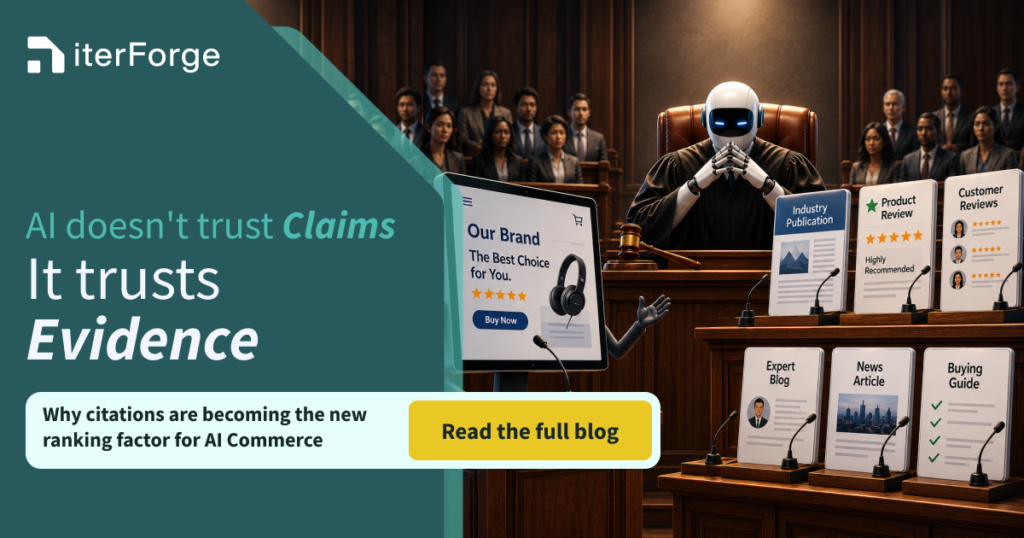
Large Language Models (LLMs) don’t simply rank websites the way traditional search engines do. They synthesize information from multiple trusted sources to generate an answer. Increasingly, being cited is becoming just as important as being ranked.
This shift is changing how ecommerce brands should think about SEO, authority, and digital visibility.
Search Has Become a Conversation
For years, ecommerce success was measured by one simple goal:
Rank higher than competitors.
Today, discovery is changing.
Consumers are asking conversational questions like:
- “What’s the best standing desk for a home office?”
- “Which running shoes are best for marathon training?”
- “Which skincare products are best for dry and sensitive skin?”
Instead of returning ten blue links, AI platforms provide one synthesized answer supported by references from multiple trusted sources.
According to McKinsey, half of consumers already use AI-powered search, and by 2028, AI-powered search is expected to influence nearly $750 billion in U.S. revenue.
For ecommerce businesses, this represents a fundamental shift:
Ranking well in search results is no longer the only measure of digital success.
It’s increasingly measured by whether AI trusts your brand enough to recommend it.
Rankings vs. References
Consider two ecommerce brands selling identical products.
Brand A
- Excellent technical SEO
- Optimized product pages
- Strong keyword rankings
Brand B
- Good SEO
- Frequently cited by industry publications
- Featured in buying guides
- Mentioned by influencers
- Referenced in expert reviews
- Consistent product information across trusted websites
When an AI model answers a customer’s question, Brand B often has an advantage.
Why?
Because AI isn’t evaluating a webpage in isolation.
It’s evaluating confidence.
The more credible signals a brand has across the web, the easier it becomes for AI to verify information before recommending it.
Citations Are AI’s Confidence Signals
Think of citations as digital proof.
Every time your ecommerce brand appears on:
- reputable publications
- trusted review websites
- industry blogs
- expert buying guides
- comparison websites
- forums
- authoritative directories
you’re creating another confidence signal.
Unlike traditional search, where backlinks were often the strongest authority signal, AI models evaluate a much broader ecosystem of information.
McKinsey notes that a brand’s own website often represents only 5–10% of the sources referenced by AI-generated answers. The remaining information comes from third-party publishers, review sites, affiliates, and user-generated content.
That’s why citations have become so valuable.
A Practical Ecommerce Scenario
Imagine two supplement brands.
Both sell creatine.
Both have similar pricing.
Both have strong customer reviews.
One appears consistently in:
- sports nutrition publications
- fitness magazines
- YouTube product reviews
- Reddit discussions
- expert comparison articles
- independent laboratory reviews
The other only publishes content on its own website.
When someone asks:
“What’s the safest creatine for beginners?”
Which brand is AI more likely to trust?
The one with multiple independent sources confirming its credibility.
This is exactly how citations strengthen Generative Engine Optimization (GEO).
Why This Matters for Ecommerce Revenue
Being recommended by AI isn’t simply about visibility.
It directly influences buying behaviour.
A recent analysis of more than 35,000 Shopify stores found that visitors arriving through AI recommendations converted at 3.6%, compared to 1.23% from traditional Google search. AI-referred visitors also generated approximately 30% more revenue per session because they arrived with stronger purchase intent.
That’s a remarkable shift.
Traditional SEO often optimizes for clicks.
AI discovery optimizes for trust before the click even happens.
Why Many Brands Still Aren’t Ready
Despite AI search growing rapidly, most organizations haven’t adapted.
McKinsey found that only 16% of brands systematically track their AI search performance.
Many ecommerce teams still focus exclusively on:
- keyword rankings
- backlinks
- organic traffic
- click-through rates
Those metrics remain important.
But they don’t answer a critical new question:
“Does AI recommend my brand?”
Without monitoring AI visibility, brands may lose share of voice even while maintaining strong Google rankings.
Also Read: Personalization Beyond Recommendations: How AI Agents Create One-to-One Commerce Experiences
Building a Citation-First GEO Strategy
The good news is that citations can’t be manufactured overnight.
They are earned through authority, consistency, and valuable content.
Here are several ways ecommerce brands can strengthen their citation profile.
Publish original insights
Unique research, industry reports, surveys, and benchmark studies provide information that journalists, bloggers, and AI systems can reference.
Original data is inherently more citable than generic content.
Create expert-led content
Buying guides, comparisons, FAQs, and educational resources help establish topical authority.
AI models frequently reference content that directly answers customer questions.
Invest in Digital PR
Mentions in reputable publications strengthen your brand’s digital footprint beyond your own website.
These independent references often carry significant weight.
Encourage authentic reviews
Verified customer reviews, expert opinions, and independent product testing all contribute additional trust signals.
Strengthen your technical foundation
Schema markup, structured product information, accurate metadata, and consistent business information make it easier for AI systems to understand and validate your content.
Also Read: How AI Sales Assistants Help B2B Commerce Teams Sell Faster Without Replacing Humans
SEO Isn’t Dead. It’s Expanding.
Some marketers frame GEO as the replacement for SEO.
That’s the wrong perspective.
- Technical SEO still matters.
- Site speed matters.
- Structured data matters.
- Content quality matters.
The difference is that SEO now extends beyond your own website.
Your entire digital ecosystem influences whether AI trusts your brand.
Think of it this way:
- SEO helps search engines find your content.
- GEO helps AI trust your content.
The two strategies are complementary, not competitive.
Also Read: AI Commerce Is Moving Beyond Clicks. Purchase Signals Are Leading the Way.
The Future Belongs to Trusted Brands
AI commerce is changing the rules of digital discovery.
Customers no longer browse dozens of websites before making a purchase.
Instead, they increasingly rely on AI assistants to summarize options, compare products, and recommend brands.
Gartner’s research shows consumers are increasingly willing to use AI to help them research products and narrow choices even if they still prefer making the final purchase decision themselves.
In this new environment, authority becomes a competitive advantage.
The brands that consistently appear across trusted publications, expert resources, customer reviews, and industry conversations are more likely to become the brands AI recommends.
Because in the age of AI Commerce, success isn’t just about being discoverable.
It’s about being credible enough to be cited.
And as AI-powered search becomes a larger part of the customer journey, citations are quickly emerging as one of the most important ranking factors for the next generation of ecommerce.