
Table of Contents
Customers today expect digital experiences that help them make quick, confident, and informed decisions, especially in B2B eCommerce. Traditional product listings such as image, title, price, add to cart – are no longer enough to support high-value, complex purchases.
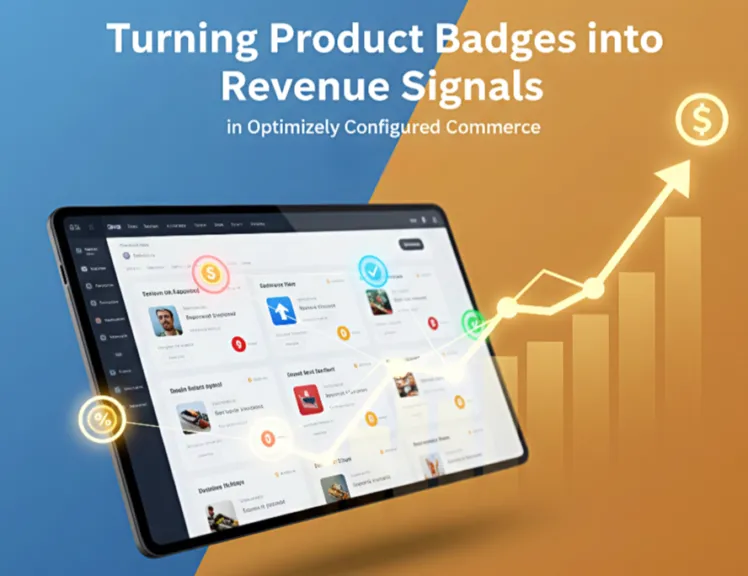
This is where product badges in Optimizely Configured Commerce make a real difference. They help transform product catalogs from static listings into experiences that guide buyers at the moment they’re deciding.
Product badging is one of the fastest ways to make an impact. With the right approach, it helps teams make better use of Optimizely by clearly guiding buyers through the catalog.
What are Product Badges in Optimizely Configured Commerce?
Product badges are visual cues that appear across:
- Search results
- Product Listing Pages (PLPs)
- Product Detail Pages (PDPs)
They quickly highlight important details such as:
- Contract-approved items
- Stock availability or backorder risks
- Volume pricing or discounts
- Unique product attributes
- Compliance or certification markers
- New, trending, or featured products
These signals help buyers move forward without having to dig through specs or reach out to support.
Also read: Boosting eCommerce Conversion Rates with Optimizely Configured Commerce
Why Product Badges Matter in B2B eCommerce
- Instant clarity for buyers Badges removes uncertainty during decision-making.
- Reduced decision friction When key information is visible early, buyers act faster.
- Higher conversions and repeat purchases Clear information builds trust over time.
- Lower support volume Common questions are answered visually.
- More effective merchandising Badges naturally draw attention to priority SKUs.
How Badge Management Works in Optimizely Configured Commerce
Optimizely enables business and merchandising teams to manage badges without relying on engineering teams.
Attribute-based badges Automatically applied using product data such as:
- Certification
- Warranty
- Product condition
- Category-specific attributes
- Sustainability markers
Rule-based badges Driven by business logic like:
- Low inventory
- Contract pricing
- Promotional price drops
- Time-based campaigns
Manual merchandising badges Ideal for:
- Seasonal promotions
- Featured collections
- Brand highlights
- Limited-time offers
Insight: Start with Buyer Questions
The most effective badge strategies start with buyer intent.
Ask yourself: What do buyers usually want to know before they purchase?
Common questions include:
- “Is there a discount on this?”
- “Is it available?”
- “Would you recommend this?”
- “Does this meet our criteria?”
When these answers become badges, your storefront becomes easier to navigate and far more helpful.
Also read: Unlocking Hidden Power in Optimizely Configured (B2B) Commerce APIs.
B2B organizations can maximize the value of Optimizely Configured Commerce through:
- Strategic digital merchandising
- Implementation and engineering
- UX enhancements
- Product data optimization
- Ongoing performance scaling
If you’re looking to boost conversions and reduce friction, product badges are a great place to start.
Small visual signals can make a big difference in how buyers experience your B2B storefront.
Learn more about our partnership with Optimizely
About Iterforge
Iterforge partners with enterprises to modernize and scale digital platforms through composable, AI-enabled, and data-driven architectures. Our teams help organizations design practical, business-ready solutions that deliver measurable outcomes in velocity, performance, and operational efficiency.
Frequently Asked Questions
What is optimizely configured commerce?
Optimizely Configured Commerce is a B2B-focused ecommerce platform by Optimizely that helps businesses sell products online with complex pricing, catalogs, and customer-specific experiences.
It is designed for manufacturers, distributors, and wholesalers who need features like:
- Custom pricing for different customers
- Bulk ordering and quick order tools
- Account-based buying experiences
- Integration with ERP and backend systems
In simple terms, it’s an ecommerce solution built specifically for businesses selling to other businesses (B2B), not individual consumers.
How is Optimizely configured commerce different from configured commerce?
The difference mainly comes down to specific platform vs general concept:
- Configured commerce (general concept):
Refers to any ecommerce setup where products, pricing, and workflows are customized based on business needs.
- Optimizely Configured Commerce (specific product):
A ready-made B2B ecommerce platform offered by Optimizely that already includes built-in tools for configuration.
Key difference:
Configured commerce is a broad approach, while Optimizely Configured Commerce is a specific solution that implements that approach out of the box.
How is Optimizely Configured Commerce used for B2B commerce?
Optimizely Configured Commerce is widely used in B2B ecommerce to handle complex buying processes that regular ecommerce platforms struggle with.
It helps businesses by enabling:
- Customer-specific catalogs: Different buyers see different products and prices
- Bulk and repeat orders: Easy reordering for frequent purchases
- Account hierarchies: Multiple users under one business account
- Real-time integrations: Sync with ERP, inventory, and order systems
- Self-service portals: Customers can place orders, track shipments, and manage accounts
This makes it ideal for industries like manufacturing, distribution, and wholesale where buying journeys are more complex than typical online shopping.
What is Optimizely Configured Commerce documentation and how can it be used?
Optimizely Configured Commerce documentation is the official set of guides, tutorials, and technical resources provided by Optimizely to help users understand and work with the platform.
It can be used by:
- Developers: To learn APIs, integrations, and customization
- Business users: To manage catalogs, pricing, and content
- Admins: To configure workflows and system settings
Typical uses include:
- Setting up a B2B ecommerce site
- Customizing features and workflows
- Troubleshooting issues
- Learning best practices for implementation
In short, the documentation acts as a complete guide to building, managing, and optimizing a B2B ecommerce experience using the platform.