Table of Contents
For years, ecommerce optimization focused on helping customers find products faster. Better search algorithms, improved filters, richer product attributes, and smarter merchandising all aimed to reduce friction between intent and purchase.
Yet despite these investments, a fundamental challenge remains.
Most shoppers don’t think in product names, SKUs, or keywords.
They think in problems, occasions, preferences, and outcomes.
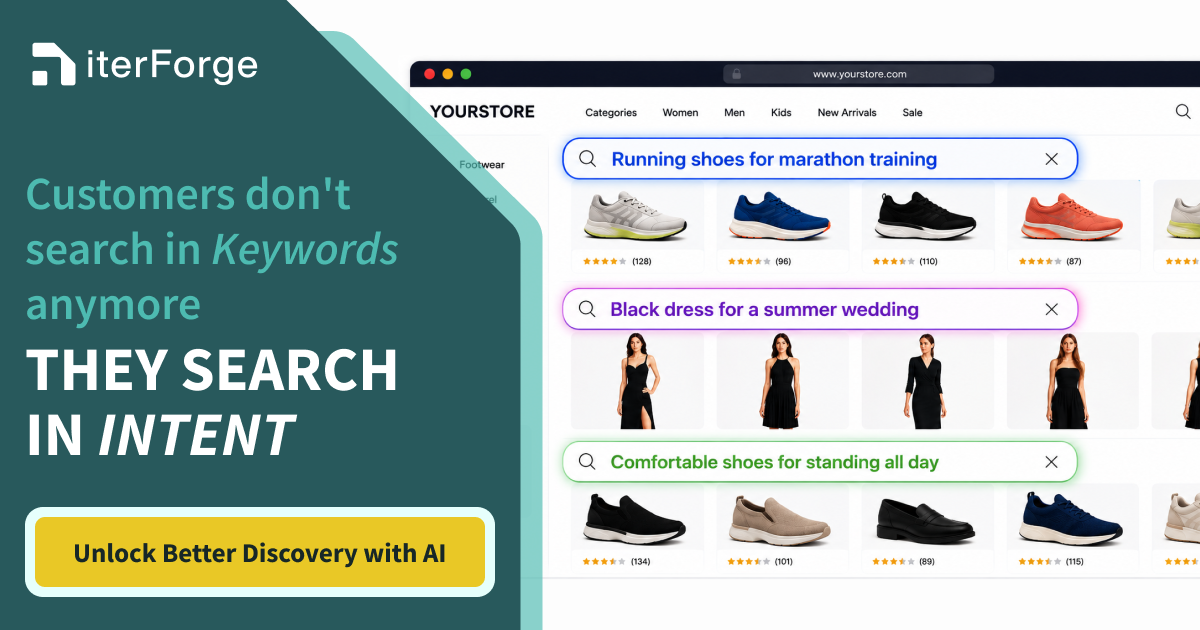
A customer isn’t necessarily searching for “15-inch lightweight laptop with 16GB RAM.” They are looking for the best laptop for college. They are not searching for a specific dress SKU; they need something appropriate for an outdoor summer wedding. They are not searching for a particular shoe model; they want footwear that can support marathon training.
This gap between how customers think and how ecommerce search works has become increasingly visible as customer expectations continue to evolve. According to Salesforce, 73% of customers expect companies to understand their unique needs and expectations.
The future of ecommerce product discovery is not about making search faster. It is about making shopping experiences more intelligent, conversational, and personalized.
This is where Agentic Commerce begins to reshape digital retail.
What Agentic Commerce Means for Product Discovery
Traditional ecommerce experiences are largely reactive.
Customers enter keywords, apply filters, browse categories, and evaluate products on their own. The website responds to customer actions but rarely participates in the decision-making process.
Agentic Commerce introduces a different model.
Instead of functioning as a product catalogue with search capabilities, the digital experience becomes an intelligent assistant capable of understanding intent, reasoning through customer needs, and guiding shoppers toward the right purchase decisions.
Customers can communicate their needs in everyday language, allowing ecommerce platforms to understand intent instead of relying solely on keyword-based searches.
For example:
- “I’m starting engineering college and need a reliable laptop that fits within my budget.”
- “Show me skincare products for sensitive skin.”
- “What’s the best gift for a 10-year-old who loves science?”
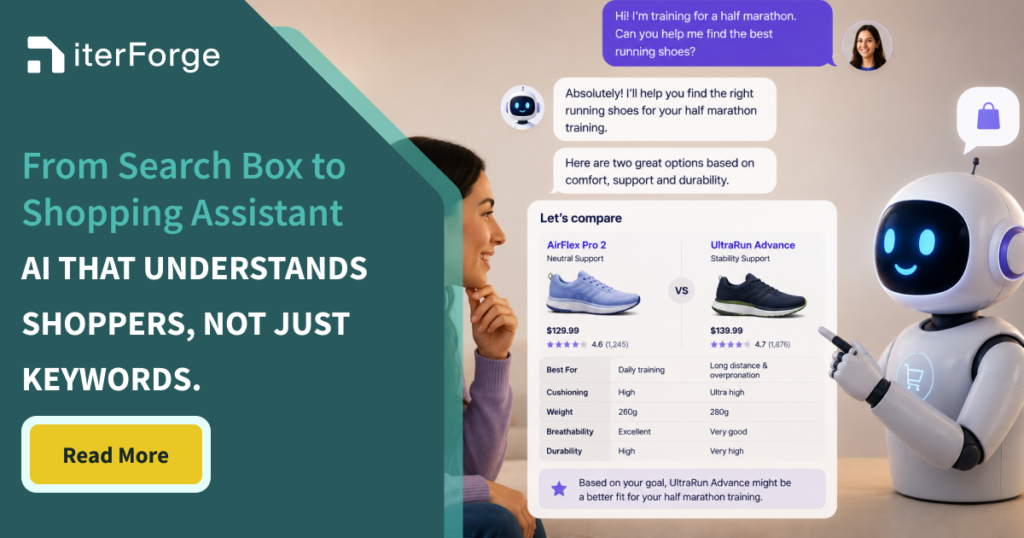
Rather than returning a generic list of products, an AI-powered shopping assistant can interpret context, ask clarifying questions, evaluate available products, and explain recommendations.
The result is an AI product discovery experience that feels less like searching a database and more like consulting a knowledgeable store associate.
Turning Search into an AI Shopping Assistant
The biggest misconception about conversational commerce is that it simply adds a chatbot to an ecommerce site.
True AI shopping assistants go much further.
These solutions bring together natural language interactions, customer insights, product information, and business logic to deliver more intelligent shopping experiences.
An effective shopping assistant should be able to:
Understand Shopper Intent
Customers often provide incomplete information.
For example:
“I need running shoes.”
A traditional search engine matches keywords.
An AI assistant understands that additional information may be required and can ask:
- Are you training for short-distance or long-distance runs?
- Do you prefer extra cushioning or lightweight shoes?
- What is your budget?
This interaction helps narrow recommendations while creating a more engaging customer experience.
Explain Recommendations
Customers frequently hesitate because they do not understand why a product is being recommended.
AI assistants can provide transparent explanations such as:
“Based on your marathon training goals and preference for extra cushioning, this model offers better long-distance comfort and durability than the alternatives.”
This builds trust and confidence during the purchase journey.
Guide Decision-Making
Many ecommerce sites excel at presenting products but struggle to support decision-making.
Shopping assistants can compare products, answer questions, summarize differences, and help customers evaluate options without forcing them to navigate multiple pages.
Leveraging Customer Behaviour Data for Recommendations
The quality of an AI shopping assistant depends heavily on the data that powers it.
Retailers already possess enormous volumes of customer intelligence spread across multiple systems:
- Ecommerce platforms
- Customer data platforms
- CRM systems
- Loyalty programs
- Marketing platforms
- Customer service systems
While retailers possess vast amounts of customer data, it often resides in disconnected systems that make it difficult to generate meaningful insights and recommendations.
When connected properly, these data sources enable highly personalized recommendations.
For example, an AI assistant can incorporate:
- Previous purchases
- Browsing history
- Product preferences
- Loyalty status
- Abandoned cart behaviour
- Regional purchasing trends
Instead of offering generic recommendations, the assistant can deliver context-aware suggestions tailored to each customer.
This transforms personalization from a marketing tactic into a real-time shopping experience.
Connecting AI to Product Catalogues and Inventory
Many retailers become excited about conversational AI only to discover that product discovery is only as good as the underlying product data.
An AI assistant cannot recommend products effectively if it lacks access to accurate catalogue information.
Successful implementations typically connect AI systems directly with:
- Product Information Management (PIM) platforms
- Ecommerce catalogues
- Inventory systems
- Pricing engines
- Promotions data
- Order management systems
This enables recommendations that are not only relevant but actionable.
For example, the assistant can recommend products that:
- Match customer requirements
- Are currently in stock
- Can be delivered within required timelines
- Qualify for active promotions
- Are available in nearby fulfilment locations
Without these integrations, conversational experiences risk becoming disconnected from operational reality.
Ensuring Relevance Through AI Ranking Models
Even with strong product data and conversational capabilities, recommendation quality remains critical.
The challenge is determining which products should appear first.
Traditional search ranking models rely heavily on keyword matching and popularity metrics.
AI-powered product discovery introduces additional dimensions such as:
- Customer intent
- Behavioural signals
- Purchase likelihood
- Product performance
- Inventory priorities
- Margin considerations
- Seasonal relevance
Modern ranking models continuously learn from customer interactions and outcomes.
Questions like these become central:
- Which recommendations lead to purchases?
- Which products are frequently ignored?
- Which conversational journeys generate higher conversion rates?
As these models improve, product discovery becomes increasingly personalized and effective.
The objective is not simply returning products. It is returning the right products in the right order for each individual shopper.
Also Read: What Breaks When Enterprise Retail Traffic Scales
How to Launch Without Replacing Your Storefront
One of the biggest concerns among retail leaders is the perceived complexity of implementation.
Fortunately, building an AI-powered shopping assistant does not require replacing an existing ecommerce platform.
Many successful retailers begin with a phased approach.
Phase 1: Add Conversational Search
Introduce natural language search capabilities while maintaining existing navigation and search experiences.
Phase 2: Connect Customer and Product Data
Integrate customer behaviour data, catalogue information, and inventory systems to improve recommendation quality.
Phase 3: Introduce Agentic Workflows
Enable the assistant to compare products, answer questions, explain recommendations, and guide customers through decision-making.
Phase 4: Expand Across Channels
Extend the experience to mobile applications, customer service channels, social commerce, and messaging platforms.
This incremental strategy reduces implementation risk while allowing organizations to measure business impact at each stage.
Also Read: Digital Experience Assurance: The Missing Layer In High-Performing Ecommerce Platforms
Governance and Digital Experience Assurance Considerations
As AI becomes more deeply embedded in customer experiences, governance becomes increasingly important.
Retailers must ensure that recommendations remain accurate, compliant, and aligned with business objectives.
Key governance considerations include:
Recommendation Transparency
Customers should understand why products are being recommended.
Data Privacy
Customer information must be handled responsibly and in accordance with applicable regulations.
Model Monitoring
AI systems should be continuously evaluated for accuracy, bias, and performance degradation.
Brand Consistency
Recommendations and responses should align with brand voice and merchandising strategies.
Digital Experience Assurance
Perhaps most importantly, retailers need confidence that AI-powered experiences perform consistently across customer journeys.
Digital Experience Assurance helps organizations monitor:
- Recommendation quality
- Conversational accuracy
- Customer satisfaction
- Conversion impact
- Performance bottlenecks
- AI response reliability
Without proper monitoring and governance, even well-designed AI experiences can create customer frustration instead of value.
The Future Belongs to Retailers That Create Better Conversations
The next generation of ecommerce leaders will not win by offering the largest product catalogues.
They will win by making product discovery feel effortless.
Customers increasingly expect digital experiences that understand intent, provide guidance, and help them make confident purchasing decisions.
AI-powered shopping assistants bridge the gap between what customers need and what traditional search experiences can deliver.
Agentic Commerce is not about replacing ecommerce websites. It is about making them more human.
Also Read: How Retailers Can Enhance Product Discovery With AI Without Rebuilding Their Commerce Platform
How Iterforge Helps Retailers Build AI-Powered Product Discovery Experiences
At Iterforge, we help retailers move beyond traditional ecommerce search and build intelligent product discovery experiences powered by AI, data, and modern commerce architectures.
Our approach combines conversational AI, customer intelligence, product catalogue integration, and Digital Experience Assurance to create shopping journeys that feel more like interactions with a knowledgeable sales associate than a search engine.
Whether organizations are exploring their first AI-powered shopping assistant or scaling enterprise-wide Agentic Commerce initiatives, we focus on practical implementations that deliver measurable business outcomes.
Our capabilities include:
- Designing and developing AI-powered shopping assistants that understand customer intent and guide purchase decisions
- Connecting AI experiences to product catalogues, inventory systems, pricing engines, CRM platforms, and customer data ecosystems
- Leveraging behavioural and transactional data to deliver personalized product recommendations
- Implementing AI ranking and recommendation models that continuously improve relevance and conversion performance
- Building scalable ecommerce data foundations that support real-time AI experiences
- Establishing governance frameworks and Digital Experience Assurance practices to ensure accuracy, performance, reliability, and trust
Most importantly, we help retailers introduce these capabilities incrementally, without requiring a complete storefront replacement. By integrating AI into existing ecommerce ecosystems, organizations can modernize product discovery while protecting prior technology investments.
As customer expectations continue to evolve, the opportunity is no longer simply helping shoppers find products faster. It is helping them make better decisions through intelligent, personalized conversations.
The retailers that succeed in the next era of commerce will be those that transform product discovery from a search experience into a guided buying experience and that’s where Iterforge helps clients create lasting competitive advantage.
The search box was built for products. Shopping assistants are built for people.
Frequently Asked Questions
How do AI algorithms improve product discovery experiences on e-commerce sites?
AI algorithms analyze customer behavior, search patterns, and purchase history to display products that are more relevant to each shopper. This reduces the time spent searching and helps customers find items that match their interests. Businesses also use ecommerce ai and data to continuously improve product visibility and create a smoother shopping journey.
How can AI personalize product recommendations on e-commerce sites?
AI personalizes recommendations by learning from browsing history, previous purchases, preferences, and real-time interactions. It then suggests products that are more likely to match a customer’s needs or interests. This level of personalization supports agentic commerce by enabling smarter and more adaptive shopping experiences.
How does AI transform traditional product search into an intelligent product discovery experience?
Unlike traditional keyword-based search, AI understands user intent, context, and product relationships to deliver more accurate results. It can recognize synonyms, correct spelling mistakes, and recommend related items even when the exact search term is missing. Combined with digital experience assurance, AI helps maintain a fast and reliable search experience across different devices and channels.
How can AI shopping assistants personalize recommendations and guide customers toward relevant products?
AI shopping assistants interact with customers in real time, answer questions, and recommend products based on preferences and shopping behavior. They can also refine suggestions as conversations continue, making the buying process more intuitive. Many retailers integrate these capabilities into their AI product development strategies to create more engaging and customer-focused experiences.