
Head of Business Development
Table of Contents
Retailers don’t have a product problem. They have a product discovery problem.
Most ecommerce businesses have invested heavily in expanding product catalogues, improving fulfilment capabilities, and optimizing customer experiences. Yet one of the biggest revenue leaks continues to happen at the very beginning of the buying journey: customers cannot find the products they are looking for.
According to Baymard Institute’s ecommerce Search UX benchmark, 56% of ecommerce sites still provide “mediocre or worse” search experiences. The challenge is not inventory availability. The challenge is that traditional search technology has not evolved at the same pace as customer behaviour.
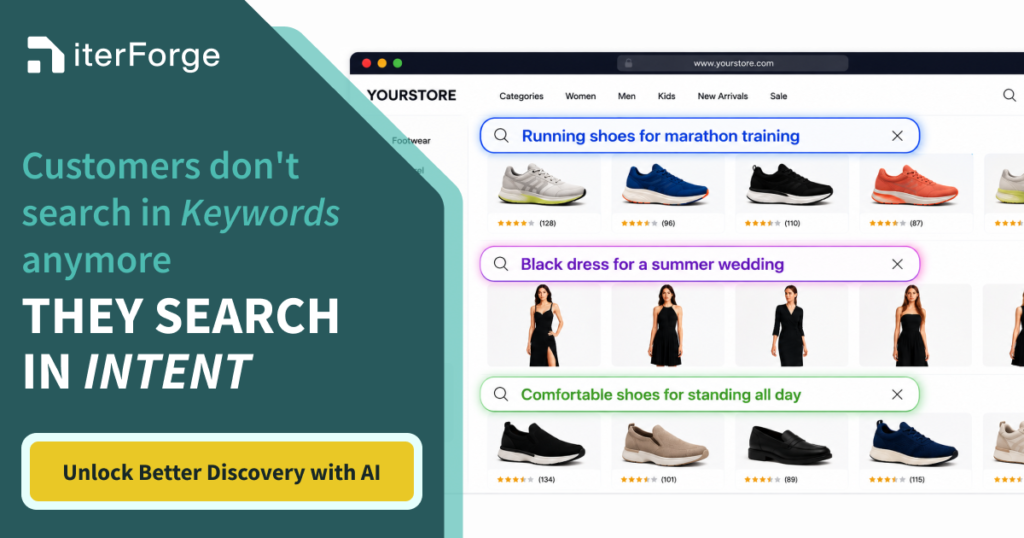
Today’s shoppers search differently. They no longer think in keywords. They think in needs, outcomes, and intent.
A customer searching for “comfortable black shoes for standing all day” is not looking for a specific product attribute. They are describing a problem they want solved.
This shift is creating a major opportunity for retailers to modernize product discovery using AI. The good news is that implementing AI-powered product discovery does not require rebuilding an entire commerce platform. Retailers can introduce modern AI capabilities alongside their existing commerce investments and progressively improve search performance, conversion rates, and customer satisfaction.
Why Traditional Keyword Search Is Failing
Most ecommerce search engines were designed around keyword matching.
If a customer searches for “running shoes,” the system looks for products containing those exact words in titles, descriptions, tags, or attributes. While effective in simple scenarios, keyword search struggles when customers use conversational language, incomplete descriptions, or intent-based queries.
Common problems include:
- Missing relevant products because exact keywords are absent
- Over-reliance on product metadata quality
- Poor handling of synonyms and alternative terminology
- Inability to understand customer intent
- Limited support for long-tail conversational searches
As AI assistants, voice search, and conversational commerce become more common, these limitations become even more visible.
Retailers that continue relying solely on keyword search risk creating friction at the exact moment customers are trying to discover products.
Implementing Natural Language Search on Existing Commerce Platforms
One of the fastest ways to improve AI Product Discovery is through Natural Language Search.
Rather than requiring customers to search using product terminology, Natural Language Processing (NLP) enables systems to understand how people naturally communicate.
For example:
Instead of:
- “Waterproof hiking boots”
Customers may search:
- “boots for trekking during monsoon season”
- “comfortable shoes for mountain trails”
- “footwear that keeps my feet dry while hiking”
AI-powered search engines can interpret these queries and connect them with relevant products even when exact keywords are not present.
The most important advantage for retailers is that Natural Language Search can often be implemented as a layer on top of existing commerce platforms.
Whether using Shopify, Adobe Commerce, Salesforce Commerce Cloud, BigCommerce, or custom commerce solutions, retailers can integrate AI-powered search services without replacing core ecommerce infrastructure.
This allows organizations to modernize customer experiences while preserving existing technology investments.
Using Context-Aware Search to Understand Customer Intent
Understanding words is only the first step.
Understanding intent is where modern AI search becomes transformational.
Context-aware search evaluates multiple signals simultaneously, including:
- Customer browsing history
- Previous searches
- Purchase behaviour
- Product popularity
- Session activity
- Geographic context
- Device behaviour
Consider two customers searching for “black shoes.”
One customer may be shopping for formal office wear.
Another may be searching for athletic footwear.
Traditional search treats both queries identically.
Context-aware AI recognizes behavioural signals and adjusts results accordingly.
This capability significantly improves relevance while reducing search abandonment rates.
As Agentic Commerce continues to evolve, intelligent systems will increasingly orchestrate search experiences dynamically, continuously learning from customer interactions and adapting recommendations in real time.
Vector-Based Catalogue Indexing for Semantic Product Discovery
One of the most important innovations driving Ecommerce AI & Data strategies is vector search.
Traditional search indexes products based on keywords and attributes.
Vector-based catalogue indexing works differently.
AI models convert product information and customer queries into mathematical representations known as vectors. These vectors capture meaning rather than exact words.
This enables semantic product discovery.
For example, a customer searching:
“minimalist work backpack for daily commuting”
may discover products described as:
- lightweight laptop backpack
- professional commuter bag
- slim office backpack
Even if those exact words never appear in the catalogue.
The result is dramatically improved product discovery across large catalogues.
For retailers with thousands or millions of SKUs, Vector Search can uncover relevant products that traditional search engines would never surface.
This is particularly valuable for fashion, furniture, beauty, electronics, sporting goods, and specialty retail sectors where customers often describe needs rather than products.
AI-Driven Ranking Models That Improve Over Time
Finding relevant products is only half the challenge.
The order in which products appear can significantly impact conversion rates.
AI-driven ranking models continuously optimize product placement based on customer engagement signals such as:
- Click-through rates
- Add-to-cart activity
- Conversion rates
- Revenue contribution
- Inventory availability
- Customer preferences
- Seasonal trends
Unlike static ranking rules, machine learning models improve over time as more customer interactions occur.
This creates a self-improving discovery ecosystem where search relevance becomes increasingly accurate.
Retailers can move beyond manually configuring search rules and allow AI to continuously refine ranking decisions based on real customer behaviour.
This is one of the foundational capabilities enabling next-generation Agentic Commerce environments.
Also Read: How Online Retailers Can Lower Customer Acquisition Costs Without More Ad Spend
Measuring Success Through Digital Experience Assurance
Implementing AI search is only valuable if performance can be measured.
Many retailers focus on deployment while overlooking ongoing validation.
This is where Digital Experience Assurance becomes critical.
Rather than simply monitoring technical uptime, Digital Experience Assurance evaluates whether customer experiences are functioning as intended.
Key metrics include:
- Search success rate
- Search abandonment rate
- Zero-result searches
- Click-through rate
- Add-to-cart rate
- Conversion rate
- Revenue per search session
- Product discovery efficiency
AI-powered search systems should be continuously monitored to ensure they are delivering measurable business outcomes.
The goal is not simply better search technology.
The goal is better customer outcomes and stronger commercial performance.
Also Read: Why An Online Retail Store Needs More Than A Standard Platform
A Practical Implementation Roadmap
Retailers often assume AI-powered product discovery requires a complete platform transformation.
In reality, the most successful implementations are usually incremental.
Phase 1: Audit Existing Search Performance
Evaluate:
- Top search queries
- Zero-result searches
- Abandonment rates
- Customer feedback
- Conversion performance
Identify where product discovery friction currently exists.
Phase 2: Introduce Natural Language Search
Deploy NLP capabilities that allow customers to search using conversational language.
This often delivers immediate improvements with relatively low implementation complexity.
Phase 3: Deploy Context-Aware Personalization
Incorporate behavioural and session-level signals to improve result relevance.
Start using customer intent rather than keywords alone.
Phase 4: Implement Vector Search
Introduce semantic indexing to improve discovery across larger and more complex product catalogues.
This becomes increasingly valuable as catalogue size grows.
Phase 5: Enable AI-Driven Ranking
Use machine learning models to continuously optimize search results based on customer interactions and business goals.
Phase 6: Establish Digital Experience Assurance
Create ongoing monitoring and optimization processes that measure business impact and ensure search performance remains aligned with customer expectations.
Also Read: Scaling Ecommerce Across Retail And Manufacturing: What Most Enterprises Get Wrong
The Future of Product Discovery Is Already Here
The future of ecommerce will not be defined by who has the largest product catalogue.
It will be defined by who helps customers discover the right products fastest.
Natural Language Search, Context-Aware Search, Vector Search, AI-driven ranking models, and Digital Experience Assurance are no longer experimental technologies. They are becoming foundational components of modern Commerce Modernization strategies.
Retailers that embrace these capabilities today can significantly improve customer experiences, increase conversion rates, and unlock greater value from existing commerce platforms.
Most importantly, they can do it without rebuilding their entire ecommerce ecosystem.
The retailers winning the next phase of digital commerce will not simply offer more products. They will make those products easier to discover through intelligent, AI-powered experiences that understand customer intent and continuously improve over time.
Frequently Asked Questions
What does enhancing product discovery with AI mean?
Enhancing product discovery with AI means helping customers find relevant products faster through personalized recommendations, smarter search, and behavior-based insights. By using ecommerce AI and data, retailers can improve the shopping experience and increase conversions.
How to use AI for personalized product recommendations?
AI analyzes customer behavior, purchase history, and preferences to recommend products that match individual interests. With effective data activation, businesses can deliver personalized recommendations across websites, apps, and marketing channels.
How does AI improve product search accuracy and relevance?
AI understands customer intent instead of relying only on exact keywords. Using AI in ecommerce, businesses can provide more relevant search results, handle synonyms and spelling errors, and help shoppers find products more quickly.
What is the difference between AI search and Traditional keyword search?
Traditional keyword search matches exact words entered by users, while AI search understands context and intent. In retail, AI-powered search delivers more accurate results by leveraging ecommerce AI and data, creating better customer experience.