
Head of Business Development
Table of Contents
Part 5 of 5: The Commerce Modernization Playbook
Part 5 brings our five-part commerce transformation series to its conclusion. We started with the Monolith Tax (Part 1), made the case for measuring before rebuilding (Part 2), explored deploying AI on legacy platforms as a strategic stepping-stone (Part 3), and walked through the composable commerce migration (Part 4). Now: what does the end state look like?
Most commerce teams think of AI as a feature. The ones who win will think of it as the operating system.
There’s a version of the future where AI agents handle search, recommendations, and a chatbot – and that’s it. Useful. Incremental. Table stakes by 2027.
Then there’s a version where AI agents don’t just assist individual customer interactions – they orchestrate the entire commerce operation. Pricing. Inventory. Merchandising. Customer service. Experience optimization. All continuously adapting, all learning from each other, all running on the composable architecture you built to support exactly this.
That second version isn’t science fiction. It’s the logical end state of everything in this series and some retailers are already building it.
From Assistants to Orchestrators
In Parts 3 and 4, AI agents were helpers. A search agent that understands intent. A shopping assistant that guides customers through complex purchases. A catalog agent that enriches product data. A service agent that handles routine inquiries.
The shift to orchestration happens when those agents stop working in isolation and start working as a system.
The recommendation agent talks to the inventory agent
It doesn’t just suggest products the customer might like – it suggests products the customer might like that are actually in stock at the nearest store for same-day pickup. It factors in margin, inventory age, and fulfillment cost before deciding what to promote.
The pricing agent talks to the demand agent
Dynamic pricing isn’t a static rule engine anymore. It’s an AI that reads real-time demand signals, competitive pricing, inventory levels, and margin targets – then adjusts pricing across channels and brands within the guardrails your merchandising team sets.
The service agent talks to the experience agent
When the AI handling customer service notices a spike in complaints about delivery delays for a specific product category, it triggers the experience agent to suppress same-day delivery promises for those SKUs until the issue resolves. No human intervention. No 48-hour lag between the problem appearing and the customer-facing experience adapting.
This is what “self-healing commerce” looks like: a system that detects anomalies, diagnoses root causes, and takes corrective action autonomously, continuously, across every channel.
The Three Layers of Agent Orchestration
Layer 1: Customer-facing agents
These are the agents your customers interact with directly. The virtual shopping assistant. The conversational search experience. The proactive order tracking notifications. The AI that creates timely, hyper-personalized shopping experiences built around each customer’s life stage and preferences.
These agents are already delivering value if you followed the playbook in Parts 3 and 4. As orchestration evolves, AI agents become smarter through a unified understanding of customer behaviour across every touchpoint.
Layer 2: Operational agents
These works are behind the scenes. Inventory rebalancing agents that redistribute stock across stores based on predicted demand. Fulfilment optimization agents intelligently route every order based on the ideal balance of cost, delivery speed, and operational capacity. Quality assurance agents that continuously monitor storefront performance and flag regressions before customers notice.
Layer 3: Strategic agents
These operate at the business level. Lifecycle marketing agents that predict customer life stages – engagement, wedding, anniversary, birthday — and orchestrate cross-brand engagement campaigns. Competitive intelligence agents that monitor pricing and assortment shifts across the market. Demand forecasting agents that inform buying and planning decisions months in advance.
Each layer feeds the others. Customer-facing agents generate data that operational agents use to optimize. Operational agents create the conditions that strategic agents analyze to inform long-term decisions. Strategic agents set the parameters within which customer-facing agents personalize.
Why Composable Architecture Makes This Possible
This level of agent orchestration is impossible on a monolith. It requires discreet, API-connected services that agents can read from, write to, and coordinate across.
Composable architecture gives AI agents what they need: clean data interfaces, modular services that can be individually optimized, and the ability to add new agent capabilities without rebuilding existing ones. The search agent is microservice. The pricing agent is a microservice. The fulfillment agent is a microservice. They communicate through well-defined APIs, operate independently, and evolve independently.
This is why the sequence in this series matters. You didn’t modernize your architecture just to be composable – you built it to power intelligent, connected AI systems.The composable platform is hardware. The AI agents are software. Together, they’re the commerce operating system.
AI Takes Over the Repetitive Work. Humans Drive the Vision
A common fear: “If AI agents run everything, what do our commerce teams do?”
The answer is: they do the work that matters.
Today, merchandising teams spend most of their time on repetitive operational work instead of strategic decision-making. AI agents take over those repetitive tasks entirely.
What’s left is strategy. Defining the brand experience vision. Setting the guardrails for AI behavior. Interpreting the insights that agent’s surface and making judgment calls that require human creativity and brand intuition. Deciding what “brand love” means and how technology should express it.
The best retailers in the AI era won’t have smaller teams. They’ll have teams focused on higher-value work, amplified by agents that handle the operational load at a speed and scale no human team could match.
Where This Leaves Us
Over five weeks, we’ve walked through the full commerce modernization journey:
Part 1 identified the problem – the monolith tax that drains revenue, speed, and competitive position every quarter you delay.
Part 2 proposed the smartest first step – a digital experience audit that turns gut feelings into a quantified, prioritized roadmap.
Part 3 introduced bridge – agentic commerce on the existing platform, delivering AI-powered results immediately while the larger transformation is planned.
Part 4 laid out the migration – progressive decoupling from monolith to composable, carrying forward every AI investment as native infrastructure.
Part 5 this one – painted the end state: AI agents evolving from assistants to orchestrators, running a self-healing, continuously optimizing commerce operation on top of the composable architecture you built.
The journey isn’t theoretical. Retailers are at every stage of it right now. Some are still calculating the monolith tax. Some are deploying AI on legacy platforms this quarter. Some are mid-migration to composable. And a few are beginning to see what agent orchestration looks like in production.
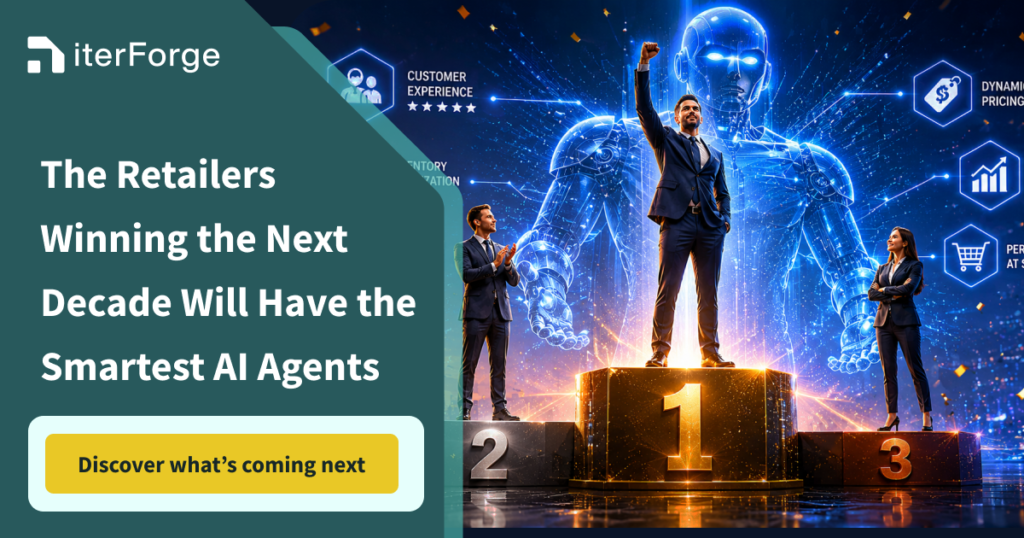
The retailers who win the next decade won’t be the ones with the best platform. They’ll be the ones with the smartest agents – and the architecture to let those agents run.
The playbook is here. The question is: where do you start?
This wraps up The Commerce Modernization Playbook series. If any part of this journey resonates – whether you’re at the monolith tax stage, the AI steppingstone, or already planning the composable migration – we’d genuinely love to hear where you are and what challenges you’re facing. Let’s keep the conversation going.
Missed an earlier installment? Here’s the full series:
Frequently Asked Questions
What does it mean for AI agents to become the commerce operating system?
When AI agents become the commerce operating system, they take on a central role in managing and coordinating key business functions. Instead of handling isolated tasks, AI agents can analyze information, make decisions, and execute actions across marketing, sales, customer service, and operations. This approach helps businesses create more connected and intelligent shopping experiences while making better use of ecommerce data.
What are the primary applications of AI agents in online retail?
AI agents can support a wide range of activities in retail, including personalized product recommendations, customer support, inventory management, demand forecasting, dynamic pricing, and marketing optimization. They help businesses respond faster to customer needs, improve shopping experiences, and streamline day-to-day operations.
How to use AI agents in ecommerce?
Businesses can use AI agents to automate repetitive tasks, assist customers through chat and voice interactions, optimize product discovery, and support decision-making. They can also help teams analyze trends, manage inventory, and improve campaign performance. As part of ai product development, AI agents can provide insights that help businesses create and improve products based on customer behavior and market demand.
What is the difference between traditional ecommerce automation and agentic commerce?
Traditional ecommerce automation follows predefined rules and workflows, such as sending emails or updating inventory when specific conditions are met. Agentic commerce, on the other hand, enables AI agents to understand goals, evaluate different options, and take actions with greater autonomy. This allows businesses to handle complex processes more efficiently and adapt to changing customer needs in real time.
What is the difference between traditional ecommerce automation and agentic commerce?
AI agents improve operational efficiency by reducing manual work, speeding up decision-making, and automating routine processes. They can manage inventory updates, answer customer inquiries, optimize pricing, and identify growth opportunities with minimal human intervention. This helps businesses save time, reduce errors, and scale operations more effectively while delivering better customer experience.