Head of Business Development
Table of Contents
Part 3 of 5: The Commerce Modernization Playbook
In Part 1, we unpacked the Monolith Tax. In Part 2, we made the case for starting with a Digital Experience Audit. Now the big question: what do you do while the re-platform is 12-18 months away, but your competitors are shipping AI-powered experiences today?
The industry has framed commerce modernization as a binary choice: stay on your monolith or migrate to composable. Pick one.
That framing is wrong. And it’s costing retailers’ years of lost revenue.
There’s a third path and it’s the one that the smartest retailers are quietly taking right now. It’s called agentic commerce: deploying AI agents on top of your existing platform to deliver the experiences your customers expect, without waiting for the re-platform to finish.
The Hidden Risk of Waiting for Re-platforming
Let’s be honest about what composable commerce migration actually involves. Twelve to eighteen months of architecture work. Millions in investment. Organizational change management. Data migration. Testing. And a hard deadline, usually a holiday season where failure isn’t an option.
During all that time, your existing platform is still running. Your customers are still shopping on it. And your competitors – the ones who’ve already modernized, or the digitally native brands who were born composable are pulling ahead with every passing quarter.
Waiting means your conversion rates continue to underperform. Your customer service costs stay high. Your product discovery remains basic. And by the time your shiny new composable platform launches, you’ve lost 18 months of ground you may never recover.
Agentic Commerce: The Intelligent Layer on Top of What You Have
Here’s the idea: your monolith isn’t going anywhere for the next 12-18 months. But that doesn’t mean the customer experience has to stay frozen.
AI agents don’t need a composable architecture to work. They need APIs, data, and a well-defined scope of action. And most legacy platforms, even the most rigid monoliths have enough integration surface to support an intelligent layer on top.
AI-powered search and recommendations.
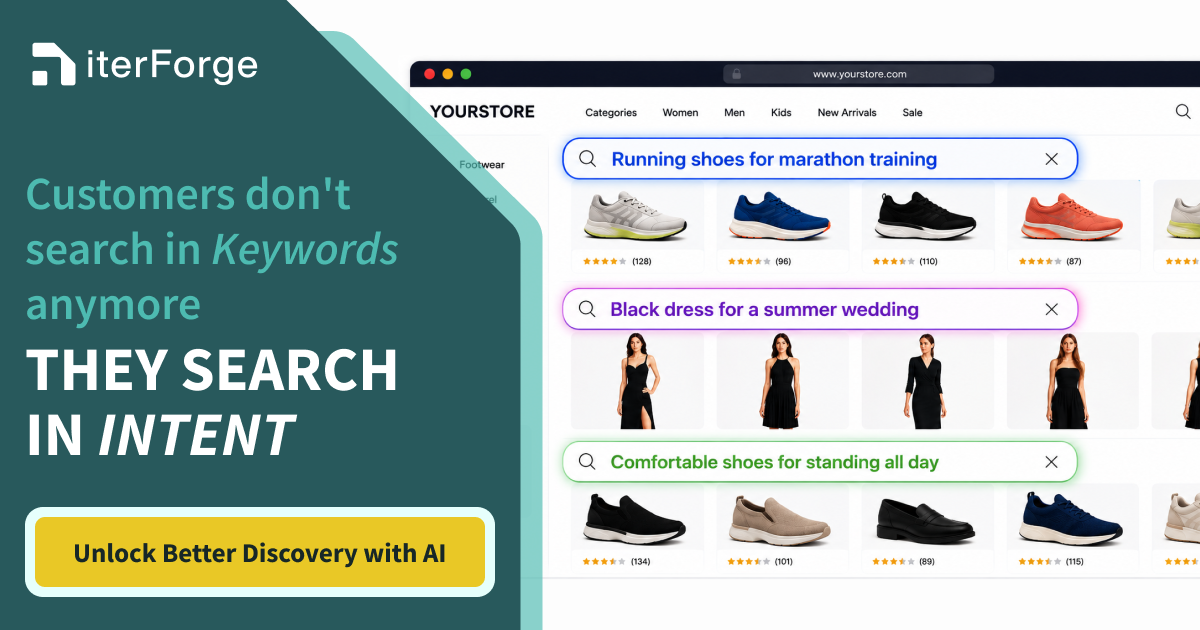
Your existing search probably returns results based on keyword matching and basic filtering. An AI layer can understand intent – “anniversary gift under $500 for someone who likes minimalist design” and return curated results that a traditional faceted search could never produce.
Virtual shopping assistants.
High-consideration purchases – engagement rings, luxury watches, fine jewelry are perfect for conversational AI. An AI-powered shopping assistant that helps customers understand diamond quality, compare budget options, and quickly discover the best fit products from a massive catalogue. This doesn’t replace your commerce platform. It sits in front of it.
Intelligent catalog enrichment.
If you manage millions of SKUs across multiple brands, your product data is probably inconsistent, incomplete, and invisible to external AI shopping agents (ChatGPT, Google Gemini). AI enrichment agents can standardize descriptions, tag attributes, optimize for search, and create structured data – all without touching your core platform.
Dynamic pricing and promotion optimization.
AI agents that analyze demand signals, inventory levels, competitive pricing, and margin targets to recommend optimal pricing, feeding decisions back into your existing pricing engine.
Proactive customer service.
AI agents that handle repair status inquiries, order tracking, return initiation, and warranty questions autonomously reducing call volume by 30-40% while improving response times from hours to seconds.
Why This Isn’t a Band-Aid – It’s a Strategy
The instinct is to dismiss this as a stop-gap. “Nice, but we still need the re-platform.” That’s true, and that’s exactly why this approach is strategic, not tactical.
It delivers ROI while you plan.
The AI agents start generating measurable value – higher conversion, lower service costs, better customer satisfaction within 8 10 weeks. That value funds the larger transformation.
It builds organizational AI muscle.
Your teams learn to work with AI-driven systems, define agent behaviors, measure outcomes, and iterate. This capability doesn’t disappear when you re-platform – it accelerates the migration.
It creates the data-backed business case.
“AI agents increased conversion by 18% on the existing platform” is the most powerful argument for investing more in the composable rebuild. You’re not guessing at ROI anymore – you’ve proven it.
It de-risks the re-platform itself.
The AI agents you build today become native services in your composable architecture tomorrow. They’re not throwaway experiments – they’re production components that migrate with you. The steppingstone becomes part of the staircase.
The Agentic Commerce Playbook
For retailers sitting on a legacy platform with a 12–18-month re-platform horizon, here’s the sequence that works:
Month 1-2:
Deploy AI search and recommendation layer on top of your existing storefront. Measure conversion lift against a control group.
Month 2-3:
Launch a virtual shopping assistant on your highest-consideration product category. Measure time-to-purchase, average order value, and customer satisfaction.
Month 3-4:
Roll out AI catalog enrichment across your highest-volume SKUs. Measure search relevance improvement and external discovery (are AI shopping agents finding your products?).
Month 4-6:
Deploy proactive customer service agents for your top 5 inquiry types. Measure call deflection and CSAT.
By month 6, you have four production AI capabilities delivering measurable business impact and a composable migration that now has a proven AI layer ready to plug into the new architecture.
You don’t have to choose between your monolith and your future. You can start winning on the platform you have today, and carry those wins forward.
But when you are ready for full migration, when it’s time to decouple the monolith and build the composable architecture, how do you do it without blowing up the business? That’s the hardest part of the journey, and it’s what most vendors won’t tell you upfront.
Next week: a practitioner’s guide to composable commerce migration – the real one, not the vendor pitch.
Follow along for Part 4: “The Composable Commerce Migration: A Practitioner’s Guide to Not Blowing It.“
Are you deploying AI on a legacy platform today? Or waiting for the re-platform before investing in AI? We’d love to hear how you’re thinking about sequencing.
Frequently Asked Questions
How does agentic commerce impact large-scale-ecommerce platforms?
Agentic commerce helps large-scale eCommerce platforms automate customer interactions, product recommendations, and decision-making processes using AI-driven systems. It can improve operational efficiency, speed up customer support, and create more responsive shopping experiences. This allows businesses to handle growing customer demands without completely rebuilding their existing platforms.
What are the fundamentals challenges of implementing AI agents in monolithic commerce system?
One of the biggest challenges is integrating AI capabilities into older systems that were not originally designed for advanced automation. Businesses may also face issues with data accessibility, scalability, and system flexibility. Strong ecommerce ai and data strategies are important to ensure AI agents can access accurate information and deliver reliable results across the platform.
What is agentic commerce on the monolith in digital retail?
Agentic commerce on the monolith refers to adding AI-powered automation and intelligent decision-making features directly into an existing monolithic eCommerce platform instead of migrating to a completely new system. Many retailers combine this approach with personalization features to improve customer experiences while continuing to use their current infrastructure.
How can one integrate agentic commerce features into a monolithic e-commerce platform?
Businesses can integrate agentic commerce features by using APIs, middleware, and AI tools that connect with their existing systems. Common integrations include AI chatbots, recommendation engines, and automated workflows. Many companies also use digital experience assurance practices to monitor performance, reduce disruptions, and maintain a smooth customer experience during implementation.