
Senior Technical Manager
Salesforce Certified Application Architect with 15+ years of experience in eCommerce and enterprise technology solutions. Specialized in Salesforce Order Management, Service Cloud, and integrated commerce ecosystems, with strong expertise in solution architecture, client engagement, and large-scale digital transformation programs.
Table of Contents
Executive Summary
In today’s fast-moving eCommerce world, customers expect seamless order experiences — real-time inventory updates, split shipments, instant refunds, and transparency at every step. But behind every “Order Confirmed” email lies a complex web of systems, integrations, and business rules.
This is where Salesforce Order Management (OMS) steps in — a cloud-native, Unified Commerce and AI-ready platform that unifies the entire post-purchase journey, from checkout to doorstep. At Iterforge, we help eCommerce brands harness Salesforce OMS to deliver frictionless fulfillment, happy customers, and operational excellence.
What Is Salesforce Order Management?
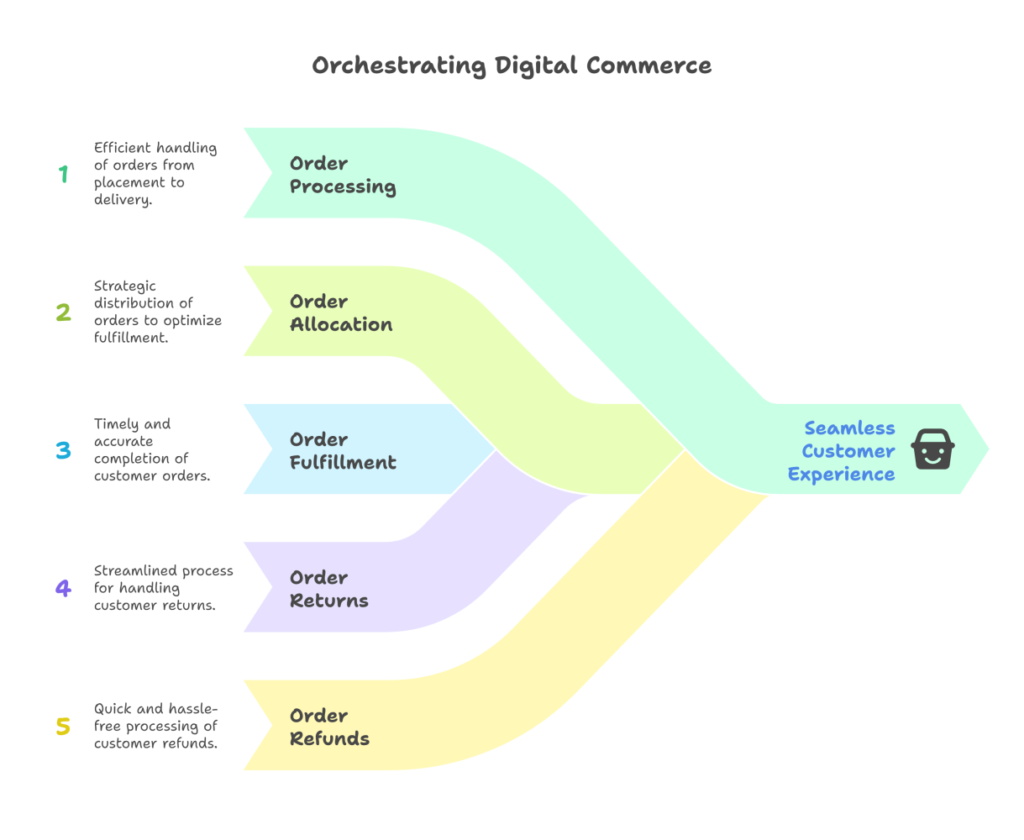
Salesforce OMS is the nerve center of modern digital commerce operations. It orchestrates how orders are processed, allocated, fulfilled, returned, and refunded — all while keeping your customer experience consistent across every touchpoint.
It connects effortlessly with your existing ecosystem — whether your storefront runs on Salesforce Commerce Cloud, Optimizely, Commercetools, or Adobe Commerce (Magento) — through APIs or middleware. That means you don’t have to replatform to enjoy enterprise-grade order management.
Why Businesses Choose Salesforce OMS
With OMS built on Salesforce’s trusted platform, your Commerce, Service, and Operations teams can finally work in sync.
Integration Flexibility — Built for Modern Commerce
Salesforce OMS is designed to be platform-agnostic. Whether you sell through a Salesforce storefront or use headless commerce platforms OMS integrates seamlessly via REST APIs or middleware (MuleSoft, Boomi, etc.).
At Iterforge, we help clients unify OMS with their ERP, PIM, WMS, and CRM systems — ensuring smooth order flow, real-time syncs, and zero reconciliation headaches.
How Iterforge Helps You Implement Salesforce OMS Right
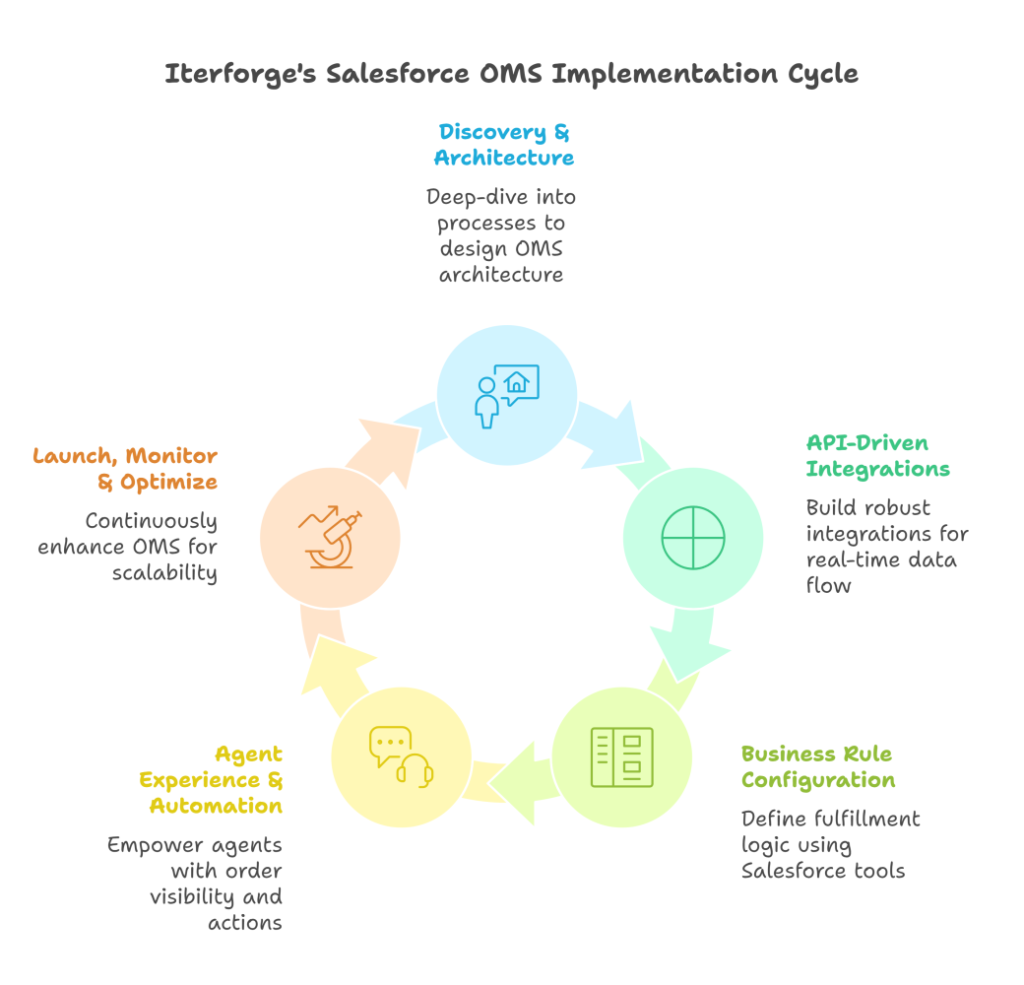
Implementing Salesforce OMS isn’t just a technical project — it’s a business transformation journey. Here’s how Iterforge partners with brands to make that journey successful.
Discovery & Architecture
We deep-dive into your current eCommerce and fulfillment processes — storefront, inventory, shipping, and service layers — to design a Salesforce OMS architecture that fits your business goals.
API-Driven Integrations
Our team builds robust integrations between Salesforce OMS and your existing ecosystem — whether that’s ERP (SAP, NetSuite), eCommerce (Optimizely, Magento, Commercetools), or logistics platforms. We ensure real-time order flow and intelligent automation.
Business Rule Configuration
Every brand’s fulfillment logic is unique.We help you define routing rules, split shipment logic, backorder handling, and refund flows, all using Salesforce Flows or Apex for precision.
Agent Experience & Automation
We configure Service Cloud and OMS together, empowering your agents with complete order visibility and pre-built refund/return actions — turning customer service into a retention engine.
Learn more about our Agentic Commerce Services
Launch, Monitor & Optimize
Post-go-live, we continuously monitor, tune, and enhance your OMS to support new SKUs, warehouses, and channels — ensuring your investment scales with your business.
Why eCommerce Leaders Choose Iterforge
Iterforge isn’t just another Salesforce OMS implementor — we’re commerce enablers. Our teams have deep expertise across Salesforce OMS, Commerce Cloud, Marketing Cloud, and Service Cloud, along with hands-on experience of implementing Salesforce multi-cloud ecosystem.
We bring
- Commerce + Operations expertise — not just tech, but process optimization
- API-first integration mindset — ensuring flexibility across your stack
- Outcome-driven delivery — focus on faster fulfillment, fewer errors, and higher Customer Satisfaction
- Cross-platform capability — we make Salesforce OMS the heart of your commerce architecture
Let’s Build the Future of Fulfillment Together
If your business is scaling fast and fulfillment is becoming your bottleneck, it’s time to modernize your order management stack. Let’s discuss how Salesforce OMS and Iterforge’s eCommerce expertise can help you streamline operations, improve customer satisfaction, and drive profitability.
Visit www.iterforge.com or reach out to us at [email protected] — let’s make your fulfillment strategy future-ready.
About Iterforge
Iterforge partners with enterprises to modernize and scale digital platforms through composable, AI-enabled, and data-driven architectures. Our teams help organizations design practical, business-ready solutions that deliver measurable outcomes in velocity, performance, and operational efficiency.
Frequently Asked Questions
What are the key features of Salesforce Order Management System?
Salesforce Order Management helps businesses manage orders from start to delivery in one place.
It is widely used in enterprise retail.
- Around 80% of retailers are using or testing AI and automation in operations.
- Companies using AI and data see up to 30% cost savings and faster order processing.
Key features include:
- Centralized order and data management
- Real-time inventory visibility
- Automated workflows using AI
- Easy integration with platforms like Salesforce and Optimizely
- Better customer experience with improved UX
These features support ai product development and digital experience assurance. They also help improve SEO by ensuring accurate product and order data.
What challenges are commonly faced during Salesforce OMS implementation?
Implementing Salesforce Order Management can be complex for large businesses.
Common challenges include:
- Data silos between systems
- Integration with legacy tools in retail, manufacturing and distribution
- Poor data quality affecting AI performance
- Customizing workflows for business needs
- Managing UX and performance across channels
Without proper planning, digital experience assurance can be affected.
A strong AI and data strategy helps reduce these issues.
How is Salesforce OMS different from traditional OMS?
Traditional OMS systems are often slow and not flexible.
Salesforce Order Management is modern and cloud-based.
Key differences:
- Uses AI and real-time data for smarter decisions
- Easily connect with ecommerce platforms like Optimizely
- Supports fast ai product development
- Provides better UX and customer journeys
- Built for modern SEO and digital commerce
It is designed for enterprise retail, unlike older systems built for basic order tracking.
What role does AI play in automating workflows in Salesforce OMS?
AI plays a key role in automating tasks in Salesforce Order Management.
It uses data to make smart decisions without manual effort.
AI helps with:
- Order routing and fulfillment
- Inventory planning
- Fraud detection
- Customer support automation
This improves speed and accuracy.
AI also supports digital experience assurance by reducing errors and improving UX.
For enterprise retail and manufacturing and distribution, AI-driven workflows increase efficiency and scalability.